


Pilot Study: West Sacramento
Pilot study methodology in West Sacramento conducted based on framework mentioned in introductions.

Choosing the Site
Yolo High School
West Sacramento, California

Yolo High School in West Sacramento, California is an alternative school for 9-12 grade which helps students stay on track for graduation. It is a very small-scale school with only about 130 students, with shorter days.
 Planter boxes constructed by students a few years back. |
|---|
 Five benches total, very little canopy cover. |
 Empty void. Unique space that connects to the neighboring Adult's School. |
 Hallway lined with shrubs |
 Chainlink fencing surrounds the border of the school and the end of hallways. |
 This campus took over a previous elementary school. |
 Smallest hallway |
 Typical hallway, covered in grass that students do not stay on. |
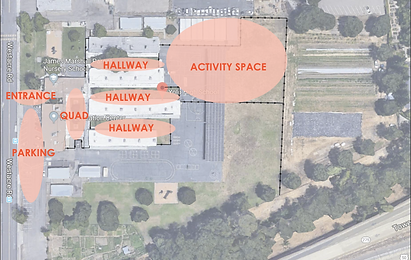
Yolo High School Campus - Site Analysis


Common High School Spaces
After observing the chosen site, five main spaces were chosen to study. Whatever the shape of school, there are several types of spaces that are common to many California schools. Studying these spaces allow a generalizable design outcome that is easy to apply to many schools.



From top left, counterclockwise: Yolo High School (West Sacramento), Davis Senior High School (Davis), River City High School (West Sacramento). Many high schools located in California have parking space, entrance, hallways, a central quad, and activity spaces as outdoor spaces.
Methodology
Site Analysis
Site analysis techniques included observations of the site during non-class hours.
Interviews
Students, teen center employee, and the principal were interviewed to expand on teen behavior (site specific) and campus usage knowledge.
Workshop (Collings Teen Center)
A workshop was conducted in a small group setting to gather information on the site and user feedback. Read more >
Common Spaces - Checklist of Key Elements

Common Spaces - Design Concepts
For each type of space, observations at Yolo High School, design guidelines, best practices that could be implemented in other sites, and a design concept for Yolo High School is shared.
Conclusion
Although each school has varying site conditions, atmospheres, and community engagement levels, some spaces are common among many schools, and require critical design thinking to accommodate for the changing environment and growing knowledge of spatial design. Adolescents have a unique way of socializing, and as the main user of the space, it should be honored when designing a high school campus. In addition, it is crucial for them to find a sense of belonging and purpose in the space they occupy, in order to maximize the positive psychological effect of the environment towards education, especially where they are supposed to belong.
In this project, the objective was to design the outdoor space without altering the existing buildings, which shows that it is possible to do quick and short-term changes to the landscape if a school is looking to implement these effects without rebuilding the entire campus. In the long-term, it would be interesting to see how the architecture can fit the key elements mentioned in this project to enhance the landscape, and together, create comfortable, engaging, and sustainable high school campuses.